Laser welded blanks are sheet metal blanks made by joining two or more sheets with different thicknesses, grades, or material properties using laser welding. The joined sheets form one welded blank that can be stamped into an automotive or industrial component.
This manufacturing method allows different materials to be placed in specific areas of one part. A thicker sheet can be used where more strength is required, while a thinner sheet can be used in areas with lower loads.
Laser welded blanks are closely related to tailored blanks, tailor welded blanks, and welded coils. The main difference is how the material is supplied and how the welded sections are prepared for the next manufacturing operation.
What Are Laser Welded Blanks?
A laser welded blank combines multiple sheet sections into one engineered blank before forming.
Instead of producing several separate components and joining them after stamping, manufacturers can join the materials first and then form the complete blank in a stamping operation.
For example, a component may require:
- Different sheet thicknesses
- Different steel grades
- Different strength levels
- Different coating specifications
- Local reinforcement
- Lower weight in selected areas
Laser welding makes it possible to combine these material sections along a defined weld line.
The result is a single welded blank designed for a specific component and forming process.
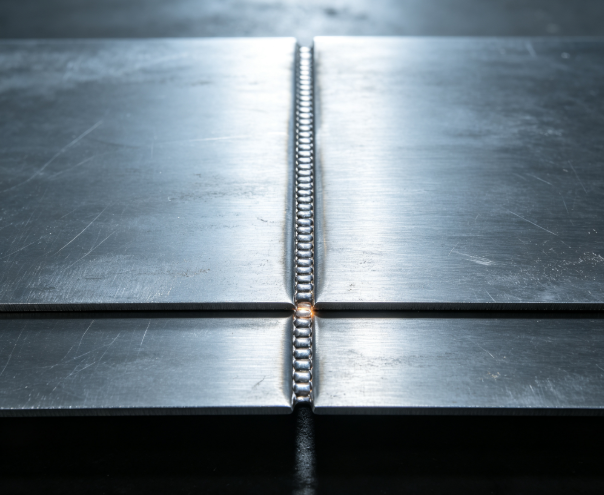
How Do Laser Welded Blanks Work?
The basic principle is straightforward.
Two or more sheet sections are prepared with accurate edges. The sheets are positioned next to each other and joined along the interface using a focused laser beam.
The laser creates a small and controlled weld zone. After welding, the combined sheet becomes a single blank that can be transferred to the next production stage.
The typical sequence is:
- Select suitable sheet materials.
- Cut the individual sheets to the required dimensions.
- Prepare and align the sheet edges.
- Laser weld the sheets together.
- Inspect the welded joint.
- Produce the required blank geometry.
- Transfer the blank to the forming or stamping process.
- Inspect the finished component.
This process allows the material distribution to be designed before forming.
Laser Welding Process for Blanks
The laser welded joint is produced by directing a concentrated laser beam onto the meeting edges of the sheets.
The welding parameters depend on the material combination and sheet geometry.
Important process variables include:
- Laser power
- Welding speed
- Beam focus
- Sheet thickness
- Material grade
- Edge condition
- Joint alignment
- Surface condition
- Coating
- Shielding gas
The objective is to produce a consistent weld with the required strength and forming performance.
For high-volume production, automated laser welding equipment can provide repeatable weld positioning and stable production speed.
Tailor Welded Blanks
Tailor welded blanks are one of the main applications of laser welded blank technology.
A tailor welded blank combines sheets with different properties before stamping. The term tailor welded refers to the way the material is selected and positioned according to the requirements of the final component.
A single blank may contain:
- 0.8 mm steel in one area
- 1.0 mm steel in another area
- 1.5 mm high-strength steel in a reinforcement area
The actual specifications depend on the component design.
This approach gives engineers more freedom to distribute material according to local strength and forming requirements.
Tailored Blanks vs. Conventional Blanks
A conventional blank normally uses the same material specification throughout the sheet.
With tailored blanks, different material sections can be combined within one blank.
| Feature | Conventional Blank | Tailored Blank |
|---|
| Material thickness | Usually uniform | Can vary |
| Material grade | Usually one grade | Multiple grades possible |
| Local strength | Limited by overall material choice | Can be optimized by zone |
| Weight optimization | More limited | Greater flexibility |
| Joining after stamping | May require additional operations | Some joining can be moved before forming |
| Material utilization | Less targeted | More targeted |
The main advantage is design flexibility. Engineers can select material based on where it is needed instead of using one specification across the entire component.
Laser Welded Coils
Welded coils use a similar concept but are supplied in a continuous coil format.
Different steel strips can be joined together before downstream processing. The resulting welded coil can then be processed through blanking, stamping, or other automated manufacturing operations.
Welded coils are suitable for production environments where continuous material handling and high-volume manufacturing are required.
The choice between a welded blank and welded coil depends on factors such as:
- Production volume
- Press line configuration
- Blank geometry
- Material handling
- Automation
- Downstream forming process
- Component requirements
Laser Welded Blanks Materials
The material combination depends on the application.
Common materials include mild steel, high-strength steel, advanced high-strength steel, galvanized steel, and selected stainless steel grades.
Mild Steel
Mild steel provides good formability and is suitable for components with moderate strength requirements.
High-Strength Steel
High-strength steel can be selected when greater mechanical performance is required without using a thicker sheet throughout the entire component.
Advanced High-Strength Steel
Advanced high-strength steels can be incorporated into tailored blanks for structural automotive components.
Different steel grades can be combined when the component requires different levels of strength and formability in different areas.
Coated Steel
Galvanized and other coated steels may be used when corrosion protection is required.
The coating must be considered during laser welding because it can affect the welding process and weld quality.
Stainless Steel
Stainless steel can be used for applications requiring corrosion resistance or specific mechanical and surface properties.
The welding parameters should be developed according to the specific stainless steel grade and material combination.
Advantages of Laser Welded Blanks
Weight Reduction
Using different sheet thicknesses allows engineers to reduce material in areas where a thinner sheet is suitable.
Stronger or thicker material can remain in areas where additional strength is needed.
Better Material Utilization
Tailored material distribution can reduce the need to use a thick or high-strength sheet across the entire component.
This can improve material efficiency while maintaining the required component performance.
Local Strength Optimization
A stronger material can be positioned in a load-bearing area, while a more formable or thinner material can be used elsewhere.
This provides greater freedom when designing stamped components.
Part Integration
Several material zones can be integrated into one blank before forming.
This can reduce the need for separate reinforcement pieces and some downstream joining operations.
Production Efficiency
Laser welding can be integrated into automated production systems. Stable welding parameters and accurate positioning support repeatable manufacturing for high-volume applications.
Automotive Applications
Laser welded blanks are widely associated with automotive sheet metal production.
Typical applications include:
Door Inner Panels
Door inner panels can require different thicknesses and strength levels in different areas. Tailored material distribution can help meet these requirements within one component.
Body Side Components
Body side structures can use different material grades or thicknesses to provide local reinforcement without increasing the thickness of the complete part.
Pillars
A-pillars, B-pillars, and other structural components may use high-strength materials in selected zones.
Floor Panels
Floor structures can benefit from tailored thickness and material distribution to balance strength and weight.
Wheel Housings
Wheel housing components may require a combination of strength, formability, and corrosion resistance.
Structural Reinforcements
Laser welded blanks can combine reinforcement areas with surrounding sheet sections before stamping.
Industrial Applications
Although automotive manufacturing is a major application, laser welded blanks can also be used in other industries.
Potential applications include:
- Industrial equipment
- Transportation equipment
- Agricultural machinery
- Heavy equipment
- Metal enclosures
- Structural sheet metal components
- Energy equipment
- Customized stamped parts
The technology is most useful when one component requires different material properties in different areas.
Laser Welded Blanks Production Process
A controlled production process helps maintain weld quality and blank dimensional accuracy.
Material Selection
The required grades, thicknesses, and surface conditions are defined according to the final component.
Sheet Preparation
Individual sheets are cut to the specified geometry. Edge quality should be controlled because the edges form the laser welding interface.
Alignment
The sheets are positioned accurately before welding.
Poor alignment can affect weld geometry and may also influence the subsequent forming operation.
Laser Welding
The sheets are joined along the designed weld line.
The laser welding parameters are selected according to the materials and thicknesses being joined.
Weld Inspection
The welded joint can be checked for appearance, dimensions, penetration, strength, and other application-specific requirements.
Blank Preparation
The welded material is prepared into the required blank shape if this step is not completed before welding.
Stamping or Forming
The finished blank is transferred to the forming process.
The weld line must remain suitable for the expected material flow and deformation during forming.
Design Considerations
A successful laser welded blank starts with the design of the final component.
Material Selection
Material grades should be selected according to strength, formability, thickness, coating, corrosion resistance, and welding compatibility.
Weld Line Position
The weld line should be positioned according to the forming behavior of the component.
Its location can affect material flow, deformation, and final dimensional accuracy.
Thickness Difference
Different sheet thicknesses can be combined, but the thickness ratio should be considered during welding and forming development.
Forming Behavior
Different materials may respond differently during stamping. Their yield strength, elongation, work hardening, and forming limits should be evaluated.
Surface Coating
Coated materials require appropriate welding parameters and process controls.
Production Volume
For large production volumes, welding speed, automation, material handling, inspection, and integration with the stamping line should be considered during process development.
Laser Welded Blanks Quality Control
Quality inspection can be performed at several stages.
Typical inspection items include:
- Material grade
- Sheet thickness
- Blank dimensions
- Edge condition
- Weld position
- Weld width
- Weld penetration
- Weld appearance
- Weld strength
- Hardness
- Dimensional accuracy
- Forming performance
The inspection method should match the component specification and customer requirements.
For automotive applications, process validation may include welding tests, forming trials, dimensional inspection, and production-line verification.
Laser Welded Blanks vs. Other Blank Technologies
Laser welded blanks are one option within a broader group of material optimization technologies.
| Technology | Basic principle | Main characteristic |
|---|
| Laser Welded Blank | Separate sheets joined by laser welding | Different materials or thicknesses in one blank |
| Tailor Welded Blank | Sheets with different properties joined before forming | Material distribution based on component requirements |
| Tailor Rolled Blank | Sheet thickness changed through controlled rolling | Continuous thickness variation |
| Welded Coil | Different strips joined into a continuous coil | Suitable for continuous processing |
The best solution depends on component geometry, material requirements, production volume, and forming technology.
How to Choose a Laser Welded Blank Supplier
When selecting a supplier, manufacturers should evaluate more than the welding machine itself.
Consider:
- Laser welding capability
- Material range
- Maximum sheet dimensions
- Thickness range
- Welding accuracy
- Production capacity
- Automated inspection
- Quality control system
- Forming and stamping experience
- Prototype capability
- Automotive industry experience
- Traceability
- Customer support
A supplier with experience in both welding and downstream forming can better understand how the welded joint will behave during production.
Frequently Asked Questions
What is a laser welded blank?
A laser welded blank is a sheet metal blank made by joining two or more sheets using laser welding. The sheets can have different thicknesses, grades, or material properties and are joined before forming.
What is a welded blank used for?
A welded blank is used to produce components that require different material properties in different areas. It can help combine strength, formability, and weight optimization within one stamped component.
What are tailored blanks?
Tailored blanks are blanks designed with different material specifications according to the requirements of the final component. They may combine different thicknesses, steel grades, or strength levels.
What does tailor welded mean?
Tailor welded means that different sheet materials are selected and joined together according to the requirements of a particular component. The sheets are normally welded before the forming process.
Why is laser welding used for blanks?
Laser welding provides a concentrated heat source and can produce accurate, narrow welds at high production speeds. It is suitable for automated production of sheet metal blanks.
Can different thicknesses be laser welded together?
Yes. Laser welding can join sheets with different thicknesses. The appropriate welding parameters and joint design depend on the material grades and thickness combination.
What are welded coils?
Welded coils are continuous coil products made by joining different steel strips together. They can be used in automated blanking and forming processes.
What materials can be used for laser welded blanks?
Depending on the application, materials can include mild steel, high-strength steel, advanced high-strength steel, galvanized steel, and selected stainless steel grades.
Can coated steel be laser welded?
Yes. Coated steel can be used for laser welded blanks. The coating type and condition must be considered when developing the welding parameters.
Are laser welded blanks suitable for automotive components?
Yes. They are suitable for many automotive stamped components, including door inner panels, pillars, floor components, body side structures, wheel housings, and reinforcement parts.
Can laser welded blanks reduce component weight?
They can. By using thinner material in suitable areas and stronger material where needed, engineers can reduce unnecessary material while maintaining the required component performance.
What is the difference between a laser welded blank and a conventional blank?
A conventional blank normally uses one material specification. A laser welded blank combines multiple sheet sections with different material properties before forming.
What is the difference between a tailor welded blank and a tailor rolled blank?
A tailor welded blank joins separate sheets through welding. A tailor rolled blank uses controlled rolling to create different sheet thicknesses, often with a gradual thickness transition.
How is a laser welded blank inspected?
Inspection can include dimensional checks, visual inspection, weld penetration checks, weld strength testing, hardness testing, and forming validation. The exact inspection plan depends on the component and customer requirements.
Can laser welded blanks be used for high-strength steel?
Yes. High-strength and advanced high-strength steels can be used in laser welded blanks when the selected grades are suitable for the welding and forming process.
Conclusion
Laser welded blanks provide a practical method for combining different sheet materials before forming. By using laser welding, manufacturers can create one welded blank from multiple sheet sections with different thicknesses, grades, or strength levels.
The technology supports the production of tailored blanks, tailor welded components, and welded coils for automotive and other sheet metal applications.
The material layout, weld position, sheet thickness, welding parameters, and forming process should be developed together. This allows manufacturers to use material where it is needed and produce components with a suitable balance of strength, weight, formability, and manufacturing efficiency.