Automotive tailor welded blanks (TWBs) are sheet metal blanks made by joining two or more steel sheets with different thicknesses, grades, or coatings before the forming process. The sheets are laser welded along a continuous weld line to create one engineered blank.
The main idea is simple: use the right material in the right area of an automotive component. A thicker or higher strength material can be used where more strength is needed, while a thinner material can be used in areas with lower load requirements. This approach helps reduce component weight while maintaining the required structural performance.
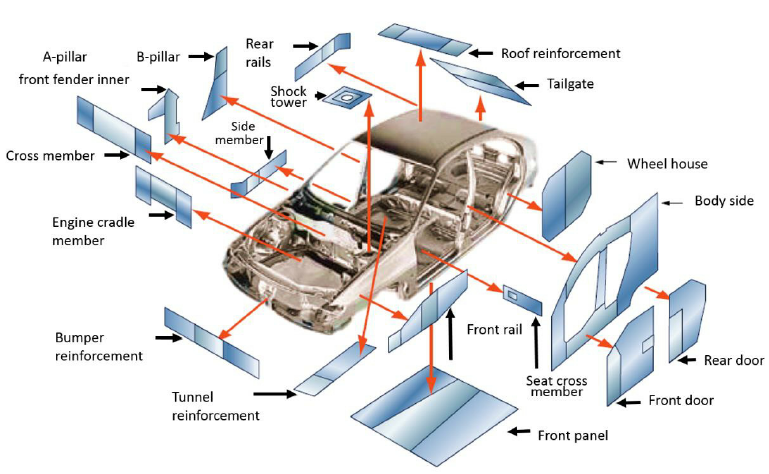
Tailor welded blanks are widely used for automotive body and structural parts, including door inner panels, side members, floor components, pillars, wheel housings, and other stamped parts.
What Are Tailor Welded Blanks?
A tailor welded blank is produced by welding multiple sheets together before stamping. Each sheet can have a different combination of thickness, strength and coating.
For example, one automotive component may require a 1.5 mm high-strength steel section in a load-bearing area and a 0.8 mm section in a lower-load area. Instead of stamping two separate parts and joining them later, these materials can be joined into a single welded blank before forming.
The resulting blank is then transferred to a stamping operation, where it is formed into the final component.
This manufacturing concept is also known as a tailored blank or tailor welded blank. The term TWB is commonly used for tailor welded blanks, while TRB refers to tailor rolled blanks and TWC refers to tailor welded coils.
Tailor welded blanks and tailor rolled blanks (TRB) are related technologies, but they use different production methods.
A TWB combines separate sheets with different properties through welding. A TRB creates a controlled thickness transition within one sheet through variable-gauge rolling.
| Technology | Main process | Material variation |
|---|
| Tailor Welded Blanks (TWB) | Laser welding | Different sheets, grades and thicknesses |
| Tailor Rolled Blanks (TRB) | Variable-gauge rolling | Continuous thickness change |
| Tailor Welded Coils (TWC) | Welding of coils or strip | Different coil sections and material properties |
TWB technology is particularly useful when a component needs clearly defined material zones. TRB technology is suitable when a gradual thickness transition is required.
Why Use Automotive Tailor Welded Blanks?
Modern vehicle manufacturers need lighter structures without reducing strength, safety, or forming performance. TWBs provide a practical way to achieve this balance.
Weight Reduction
Using thinner steel in low-load areas can reduce the total mass of a stamped component. Material is added only where the component needs greater structural support.
Better Material Utilization
Improved materials utilization is one of the main advantages of tailored blank technology. Instead of using the thickest or strongest material throughout an entire component, engineers can select materials according to local requirements.
This reduces unnecessary material use and can also lower the amount of scrap generated during manufacturing.
Higher Local Strength
Different grades of advanced high strength steels (AHSS) can be combined within the same blank. A stronger steel section can be positioned in areas exposed to higher loads or deformation requirements.
This allows manufacturers to achieve a better balance between weight and structural strength.
Fewer Assembly Operations
A TWB can combine material sections that would otherwise require separate stamped parts. After stamping, the finished component may require fewer joining operations.
This can simplify the production process and reduce the number of components used in an assembly.
Better Part Integration
Tailored blanks allow engineers to design a component around its actual load conditions. Material properties can be distributed within one stamped part instead of designing several separate parts and joining them afterward.
Automotive Tailor Welded Blank Materials
The choice of material depends on the component design, forming requirements, strength target, corrosion requirements, and manufacturing process.
Common materials include:
Advanced High Strength Steels
Advanced high strength steels are widely used in modern vehicle structures. Grades such as DP, TRIP, CP and martensitic steels can be selected according to the required strength and forming characteristics.
Different AHSS grades may be combined in a single blank when the component requires different performance zones.
Mild and High-Strength Steels
Mild steel and conventional high-strength steel can also be combined with stronger grades. This is useful when some areas of a component require formability while other areas require greater strength.
Stainless Steel
Stainless steel can be used for selected applications where corrosion resistance, surface performance, or specific mechanical properties are required. The welding process must be matched to the selected stainless steel grade and the material used on the other side of the weld.
Coated Steel
Galvanized and other coated steels are common in automotive applications because corrosion protection is important for vehicle body components.
When coated materials are welded, the coating system and welding parameters need to be considered during process development.
Tailor Welded Blanks Production Process
The production process for automotive TWBs normally includes material preparation, cutting, positioning, welding, inspection, and forming preparation.
1. Material Selection
The required steel grades and sheet thicknesses are selected according to the final component design.
Engineers consider strength, formability, coating, thickness, weldability, and forming behavior.
2. Sheet Cutting
Individual sheets or blanks are cut to the required dimensions. Edge quality is important because the two sheets must be accurately aligned before welding.
3. Edge Preparation and Positioning
The sheets are positioned along the planned weld line. Dimensional accuracy is needed to maintain the specified joint location and blank geometry.
4. Laser Welding
The prepared sheets are joined using a laser welded joint.
Laser welding is widely used for TWBs because it can produce a narrow weld zone with controlled heat input and high production speed.
A continuous weld is normally created along the joint between the different sheet sections.
5. Weld Inspection
The welded joint is inspected to verify weld quality and dimensional accuracy. Depending on the application, inspection may include visual inspection, dimensional checks, destructive testing, or non-destructive testing.
6. Blanking and Forming
After welding and inspection, the completed blank is prepared for stamping. The TWB is then formed into the required automotive component.
The weld line must be positioned correctly because the forming operation can subject the joint to tensile, compressive, and bending loads.
7. Heat Treatment
For selected steel grades and manufacturing routes, heat treatment may be incorporated into the process. The exact treatment depends on the steel grade, forming technology, and required mechanical properties.
For hot stamping applications, the material behavior during heating, forming, and cooling must be considered as part of the overall process design.
Laser Welding for Tailor Welded Blanks
Laser welding is an important joining method for TWB production.
The laser beam creates a concentrated heat source at the joint between two sheets. This makes it possible to produce a narrow weld with limited heat-affected areas.
The welding process must be adjusted according to:
- Steel grade
- Sheet thickness
- Thickness difference
- Coating type
- Joint design
- Welding speed
- Laser power
- Beam focus
- Shielding gas
- Surface condition
When different materials are joined, the weld zone must be evaluated for strength, hardness, ductility, and forming behavior.
Thickness, Strength and Coating Selection
One of the main advantages of TWB technology is the ability to combine different thickness, strength and coating specifications in one blank.
For example, a door inner panel may require different material characteristics around mounting points, reinforcement zones, and areas with lower structural loads.
A typical design may combine:
- Thin sheet for weight reduction
- Thick sheet for reinforcement
- AHSS for higher strength
- Coated steel for corrosion protection
- More formable steel in areas with complex geometry
The exact combination depends on the vehicle platform and component requirements.
Tailor Welded Blanks for Hot Formed Components
TWBs can also be used with hot formed automotive components.
Hot stamping is commonly used for high-strength vehicle parts that require high tensile strength after forming. Tailored blanks can combine different materials or thicknesses before the hot forming operation.
During the process, the blank is heated, transferred to the forming tool, formed, and cooled under controlled conditions.
Material selection, weld behavior, heating conditions, forming temperature, cooling rate, and heat treatment requirements must be considered together.
Automotive Applications
Automotive tailor welded blanks can be used in many body and structural components.
Door Inner Panels
Door inner panels are a common application because different areas of the panel may have different strength and thickness requirements.
Body Side Components
Tailored blanks can be used for side structures where local reinforcement is required without increasing the thickness of the entire component.
Pillars
A-, B-, and other structural pillars can use high-strength materials in areas where additional structural performance is required.
Floor Components
Floor panels and related structural components can benefit from different sheet thicknesses and steel grades within one stamped part.
Wheel Housings
Tailored material distribution can help meet local strength, forming, and weight requirements in wheel housing components.
Reinforcement Components
Local reinforcement areas can be produced using thicker or stronger material sections within the same blank.
Tailor Welded Coils
Tailor welded coils (TWC) extend the tailored material concept from individual blanks to coil-based production.
Different steel strips can be joined by welding to create a continuous coil with specified material sections. This can support high-volume manufacturing and automated downstream operations.
TWC technology is different from individual tailor welded blanks because the material is supplied in a continuous coil format rather than as a finished blank.
For high-volume automotive production, the choice between blanks and coils depends on the press line, material flow, component geometry, production volume, and automation system.
Tailor Welded Solutions for Automotive Manufacturing
A complete tailor welded solutions approach should start with the finished component rather than the welding process alone.
The material layout is developed according to the load conditions and forming requirements of the part.
The engineering process may include:
- Component requirement analysis
- Material grade selection
- Thickness optimization
- Weld-line design
- Blank geometry development
- Laser welding process development
- Forming simulation
- Prototype production
- Weld and material testing
- Stamping validation
- Production process optimization
This approach helps manufacturers select a suitable combination of higher strength material, thickness, coating, and forming conditions.
TWB Quality Control
Quality control is needed at several stages of TWB production.
Typical inspection points include:
- Sheet thickness
- Material grade
- Surface condition
- Coating condition
- Blank dimensions
- Weld position
- Weld penetration
- Weld width
- Weld strength
- Hardness
- Weld-line straightness
- Forming performance
- Final component dimensions
For automotive applications, quality requirements should be defined according to the component specification and applicable customer standards.
TWB Design Considerations
Several factors should be evaluated before developing a tailor welded blank.
Material Compatibility
The selected materials must be suitable for the intended welding and forming process.
Thickness Ratio
Large differences in sheet thickness can affect heat flow, weld behavior, and forming performance. The joint design should account for these differences.
Weld-Line Location
The weld line should be positioned according to the expected deformation during stamping. Its location can affect material flow and the final component shape.
Forming Behavior
Different steel grades can have different yield strength, elongation, hardening behavior, and forming limits. These differences should be included in forming analysis.
Coating
Coated sheets require appropriate welding parameters and process controls. Coating behavior near the weld should also be evaluated.
Production Volume
For high-volume automotive production, welding speed, automation, blank handling, inspection, and line integration all need to be considered.
Automotive TWB vs. Conventional Blanks
Conventional blanks normally use one material specification across the complete blank. If different material properties are needed, separate components may be stamped and joined later.
A TWB integrates different material zones before forming.
| Feature | Conventional Blank | Tailor Welded Blank |
|---|
| Material zones | Usually one specification | Multiple specifications |
| Thickness | Usually uniform | Can vary |
| Steel grades | Usually one grade | Multiple grades possible |
| Local reinforcement | Often requires additional parts | Can be integrated into blank |
| Material utilization | Less optimized | More targeted |
| Weight reduction | Limited by uniform material design | Greater design flexibility |
| Production approach | Separate parts may be required | Multiple zones formed as one blank |
Frequently Asked Questions
What is an automotive tailor welded blank?
An automotive tailor welded blank is a sheet metal blank made by joining two or more steel sheets with different thicknesses, grades, or coatings. The sheets are usually joined by laser welding before stamping.
What does TWB stand for?
TWB stands for Tailor Welded Blank. It describes a blank made by welding different sheet materials together before the forming process.
What is the difference between TWB and TRB?
TWB uses welding to join separate sheets with different material properties. Tailor rolled blanks (TRB) use variable-gauge rolling to create a controlled thickness transition within the sheet.
What materials are used for tailor welded blanks?
Common materials include mild steel, high-strength steel, advanced high strength steels, galvanized steel, and selected grades of stainless steel. Material combinations depend on the component requirements.
Why are laser welds used for TWBs?
Laser welding provides a concentrated heat source and can produce a narrow, continuous joint at high production speeds. This makes it suitable for joining sheet sections before stamping.
Can different thicknesses be welded together?
Yes. One of the main purposes of TWB technology is to join sheets with different thicknesses. The welding and forming process must be designed for the specific thickness combination.
Can TWBs use coated steel?
Yes. Galvanized and other coated steels can be used in TWB production. The coating type must be considered when setting welding parameters and evaluating weld quality.
Can tailor welded blanks be used with AHSS?
Yes. Advanced high strength steels can be incorporated into TWBs when their strength and forming properties meet the requirements of the application.
What are tailor welded coils?
Tailor welded coils (TWC) are continuous coil products made by welding different steel strip sections together. They are designed for continuous or automated production systems.
What is a thickness transition in a TWB?
A thickness transition is the point or region where one sheet thickness changes to another. In a TWB, this transition is normally created by joining sheets with different thicknesses.
Are TWBs suitable for hot stamping?
Yes. TWBs can be designed for hot formed automotive components. The steel grades, weld properties, heating conditions, forming process, cooling rate, and heat treatment requirements must be evaluated together.
What automotive parts use tailor welded blanks?
Typical applications include door inner panels, pillars, floor components, side structures, wheel housings, reinforcement components, and other stamped body parts.
How do TWBs improve material utilization?
TWBs allow engineers to use material based on local requirements. A stronger or thicker section can be placed where loads are higher, while thinner material can be used in lower-load areas. This supports improved materials utilization and weight reduction.
Can TWBs reduce vehicle weight?
Yes. By using thinner material in suitable areas and higher strength material where required, TWBs can reduce component mass while maintaining the required performance.
Conclusion
Automotive tailor welded blanks provide a flexible way to combine different steel grades, thicknesses, strengths, and coatings in one stamped component. Through laser welding, material sections can be joined before forming and then processed as a single blank.
The technology supports lightweight vehicle design, better material utilization, local strength optimization, and part integration. Depending on the application, manufacturers can select TWBs, tailor rolled blanks (TRB), or tailor welded coils (TWC) to match their production and component requirements.
For automotive manufacturers, the best tailored blank design starts with the component's actual load, forming, corrosion, and production requirements. This helps determine the right material combination, weld location, thickness distribution, and production process for reliable high-volume manufacturing.