Custom tailor welded blanks are sheet metal blanks made by laser welding two or more steel sheets with different thicknesses, strength levels, grades, or coatings before the forming operation. By combining materials within one blank, manufacturers can place the required material properties where they are needed in the finished component.
This approach is widely used for automotive body and structural components, where weight reduction, strength distribution, forming performance, and material efficiency need to be considered together. Depending on the application, custom tailor welded blanks can be produced from conventional steels, high-strength steels, or advanced high strength steels, including combinations with different thickness and coating specifications.
What Are Custom Tailor Welded Blanks?
Custom tailor welded blanks are engineered blanks designed around the requirements of a specific stamped or hot formed component.
Instead of manufacturing an entire component from one sheet specification, different steel sections can be joined through a continuous weld. A thicker or stronger material can be positioned in a high-load area, while a thinner or more formable material can be used where lower strength is sufficient.
This creates a tailored material structure before forming.
A custom tailor welded blank may therefore combine:
- Different sheet thicknesses
- Different steel grades
- Different strength levels
- Different surface coatings
- Different forming characteristics
- Different material specifications within one blank
The weld line, thickness transition, material combination, and blank geometry are designed according to the requirements of the final component.
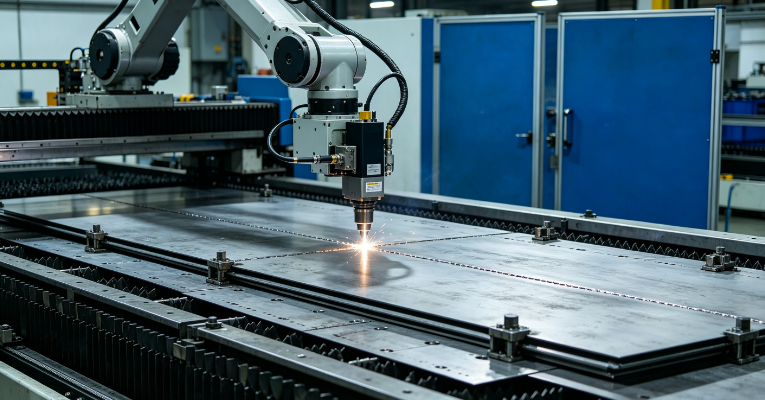
Custom Tailor Welded Blank Manufacturing Process
The production process starts with material and component requirements rather than with welding alone. The supplier needs to understand the finished part, forming method, loading conditions, dimensional requirements, and material specifications before defining the blank structure.
Material Selection
The first step is selecting suitable materials for the application. Common options include mild steel, high-strength steel, and advanced high strength steels.
For automotive applications, the selection may also consider galvanized or other coated materials, depending on corrosion protection and surface requirements.
The combination of thickness, strength and coating should be evaluated together because these factors affect welding, forming, surface quality, and final component performance.
Sheet Cutting and Preparation
Individual sheets are cut according to the required blank geometry. The edges that will be welded need to be prepared and positioned accurately.
Consistent edge quality helps maintain the required weld condition and dimensional accuracy.
Laser Welding
Laser welding is widely used to join the individual sheet sections. The concentrated laser beam creates a continuous weld along the designed joint.
Laser welded blanks can be produced with accurate weld positioning and relatively narrow heat input compared with many conventional welding methods. Welding parameters are adjusted according to material grade, thickness, surface condition, joint configuration, and production requirements.
Weld Inspection
After laser welding, the weld is inspected for continuity, surface condition, dimensional accuracy, and other specified quality requirements.
Depending on the application, inspection may include visual inspection, dimensional measurement, weld monitoring, destructive testing, or non-destructive testing.
Blanking and Forming
The welded assembly is processed into the required blank geometry and then supplied for forming.
Depending on the application, the blank may undergo stamping, deep drawing, or a hot forming process.
Laser Welded Blanks for Automotive Manufacturing
Laser welded blanks are widely associated with automotive body manufacturing because they allow different material specifications to be integrated before forming.
A conventional blank may require one material specification across the entire component. A laser welded blank allows the material layout to be optimized before the part is formed.
This can support:
- Reduced component weight
- Better material distribution
- Improved materials utilization
- Local strength optimization
- Reduced material consumption
- Part integration
- Fewer secondary joining operations
The weld itself becomes part of the engineered blank rather than an additional joining operation performed after several individual components have already been formed.
Thickness, Strength and Coating Optimization
One of the main advantages of tailor welded blanks is the ability to combine different material characteristics within a single blank.
Thickness Transition
A thickness transition occurs where one sheet thickness changes to another across the weld line.
For example, a blank may combine a thicker sheet in a structural reinforcement area with a thinner sheet in a region where lower weight or improved forming performance is preferred.
The location of the thickness transition needs to be considered carefully because it can influence material flow, forming behavior, dimensional accuracy, and final component properties.
Strength Distribution
Different steel grades can be positioned according to the expected loads on the finished part.
High-strength steel or advanced high strength steels can be used in areas requiring greater structural performance, while more formable grades can be selected for areas with demanding deformation requirements.
Coating Selection
Coating requirements also need to be considered during material selection and welding development.
Galvanized and other coated steels may be used in automotive applications where corrosion protection is required. Welding parameters need to be developed according to the selected coating system and material combination.
Advanced High Strength Steels
Advanced high strength steels are increasingly used in automotive structures where manufacturers seek a balance between strength and weight.
Combining advanced high strength steels with tailor welded blanks allows different grades and thicknesses to be distributed within a single component.
Rather than using the highest-strength material throughout the entire blank, engineers can specify material properties according to local requirements.
This can help achieve a more efficient balance between:
- Strength
- Weight
- Formability
- Material consumption
- Crash performance
- Manufacturing requirements
The suitability of a particular advanced high strength steel combination depends on its welding characteristics, forming behavior, thickness, coating, and final application.
Tailor Welded Blanks vs Tailor Rolled Blanks TRB
Tailor welded blanks and tailor rolled blanks use different methods to create localized material properties.
A tailor welded blank is produced by joining separate sheets with different specifications through a weld line. The material changes occur at defined welded joints.
Tailor rolled blanks, or tailor rolled blanks TRB, are produced by continuously varying sheet thickness through a rolling process. The thickness transition is created within the sheet rather than by joining separate sheets.
The two technologies can therefore serve similar weight and material optimization objectives but use different production methods.
| Feature | Tailor Welded Blanks | Tailor Rolled Blanks |
|---|
| Material structure | Separate sheets joined together | Thickness varies within one rolled sheet |
| Thickness change | Defined by weld joints | Continuous or controlled rolling transition |
| Material grades | Can combine different grades | Generally based on rolling-compatible material |
| Production method | Laser welding | Controlled rolling |
| Design flexibility | High for discrete material zones | High for gradual thickness changes |
The appropriate solution depends on the component geometry, material requirements, production volume, and forming process.
Tailor Welded Coils TWC
Tailor welded coils TWC extend the concept of tailor welded blanks into continuous coil production.
Instead of producing only individual blanks, different strip sections can be joined into a continuous welded coil. The resulting blanks and coils can then be integrated into automated manufacturing systems.
Tailor welded coils may be considered when production volume, automated blanking, material handling, and continuous processing are important factors.
The selection between individual blanks and tailor welded coils depends on the customer's production process, component geometry, material combinations, and required production rate.
Tailor Welded Solutions for Automotive Components
Tailor welded solutions can be developed for a wide range of automotive body and structural components.
Door Inner Panels
Door inner panels often require a combination of structural performance, dimensional stability, forming characteristics, and weight control.
Custom tailor welded blanks can place different material thicknesses or grades within the door inner panel according to local requirements.
Pillars
A-pillars and B-pillars are structural body components that can benefit from localized strength distribution.
The blank can be designed with stronger material in areas subjected to higher structural loads while using other material specifications in less demanding regions.
Floor Components
Floor structures often contain areas with different stiffness and strength requirements.
Tailor welded blanks can provide a material layout designed around those variations rather than applying the same material specification across the complete component.
Wheel Housings
Wheel housings require suitable forming characteristics as well as structural performance.
A tailored blank can combine different thicknesses or grades to match the geometry and load requirements of the finished component.
Structural Reinforcements
Reinforcement components can use thicker or higher-strength steel in selected areas without requiring the entire component to be manufactured from the same high-specification material.
Hot Formed Tailor Welded Blanks
Tailor welded blanks can also be used for hot formed automotive components.
In a hot forming application, material selection and the welding process need to be evaluated together with the heating and forming conditions.
The production process may include:
- Material preparation
- Sheet cutting
- Edge preparation
- Laser welding
- Weld inspection
- Blank preparation
- Heating
- Hot forming
- Heat treatment or controlled cooling
- Final inspection
For hot formed components, the behavior of the weld and adjacent material during heating and forming must be considered during process development.
Heat Treatment and Forming Performance
Heat treatment requirements depend on the selected materials and the forming technology.
For hot formed components, thermal processing can change the mechanical properties of the steel. The weld zone and heat-affected region therefore need to be evaluated together with the parent materials.
For cold forming applications, the focus may instead be placed on material flow, weld-line behavior, forming limits, springback, and dimensional stability.
The final process should be developed around the actual material combination and finished component rather than applying one standard process to every tailored blank.
Continuous Weld Quality
A continuous weld provides a consistent joining path between the different sheet sections.
For production applications, weld quality should be monitored throughout the production process. Factors such as laser power, welding speed, beam alignment, material positioning, joint condition, and surface characteristics can influence weld performance.
Consistent process control helps maintain the required weld geometry and mechanical properties from one blank to the next.
Improved Materials Utilization
Improved materials utilization is one of the main reasons manufacturers consider tailor welded blanks.
With a conventional blank, the entire sheet may need to meet the requirements of the most demanding area of the finished component.
With a tailored blank, material can be distributed according to local requirements.
For example:
- Thicker material can be used in high-load zones.
- Thinner material can be used in lower-load areas.
- Higher-strength steel can be placed where structural performance is required.
- More formable material can be used in areas requiring greater deformation.
This approach can reduce unnecessary material and provide a more efficient material structure.
Weight Reduction and Part Integration
Tailor welded blanks can contribute to vehicle weight reduction by reducing the amount of material used in areas that do not require maximum thickness or strength.
They can also support part integration.
Several individual components may sometimes be replaced by a single tailored blank that is formed into a more integrated structure. This can reduce the number of joining operations and simplify downstream assembly.
The actual weight and cost benefits depend on the component design, material combination, production volume, and forming process.
Custom Tailor Welded Blanks for Different Production Requirements
Not every application requires the same blank design.
A custom solution may be developed around:
- Material grade
- Sheet thickness
- Coating
- Weld line location
- Blank dimensions
- Component geometry
- Forming method
- Production volume
- Surface requirements
- Dimensional tolerances
The supplier and component manufacturer can work together to determine the appropriate material combination and production process.
Tailored Blanks, Welded Coils and Tailored Tube Technologies
Tailored material technologies are not limited to flat blanks.
Tailored Blanks
Tailored blanks combine different sheet materials in a flat blank before forming. They are widely used for automotive stamped components.
Welded Coils
Welded coils provide a continuous material format and can support automated blanking and high-volume production.
Tailored Tube
A tailored tube applies a similar material optimization concept to tubular structures. Different tube sections, wall thicknesses, or material specifications can be combined to meet localized performance requirements.
The choice between a flat tailored blank and a tailored tube depends primarily on the geometry and manufacturing method of the finished component.
Quality Control in Tailor Welded Blank Production
Quality control covers the complete production process rather than only the final weld.
Typical inspection areas include:
- Raw material verification
- Sheet thickness
- Material grade
- Surface condition
- Coating condition
- Sheet dimensions
- Edge quality
- Weld alignment
- Continuous weld quality
- Weld geometry
- Blank dimensions
- Forming performance
For automotive production, inspection criteria can be established according to customer drawings, technical specifications, quality standards, and application requirements.
Choosing a Tailor Welded Blanks Manufacturer
When comparing tailor welded blanks manufacturers, it is useful to evaluate more than laser welding equipment.
Consider the manufacturer's ability to manage the complete production process, including:
- Material selection
- Steel grade combinations
- Thickness combinations
- Coated materials
- Laser welding
- Weld inspection
- Blank cutting
- Dimensional control
- Forming development
- Automotive component experience
- Production capacity
- Quality management
A supplier with experience in custom tailor welded blanks should be able to discuss the material structure and weld configuration in relation to the finished part.
Custom Tailor Welded Blanks for Automotive Applications
Custom tailor welded blanks provide manufacturers with a way to design the material structure of a component before forming.
By combining different thicknesses, strength levels, grades, and coatings through laser welding, a single tailored blank can be engineered for different requirements within the same component.
This makes the technology suitable for automotive applications where weight, strength, forming performance, material efficiency, and production requirements need to be considered together.
Frequently Asked Questions
What are custom tailor welded blanks?
Custom tailor welded blanks are sheet metal blanks made by laser welding two or more sheets with different thicknesses, grades, strength levels, or coatings before forming.
What is the difference between tailor welded blanks and tailor rolled blanks TRB?
Tailor welded blanks combine separate sheets through welding, while tailor rolled blanks TRB use a rolling process to create controlled thickness variations within the sheet.
What materials can be used for tailor welded blanks?
Common materials include mild steel, high-strength steel, advanced high strength steels, cold-rolled steel, and selected coated steel grades. Material selection depends on the application and forming process.
Why is laser welding used for tailor welded blanks?
Laser welding provides a concentrated heat source and can produce an accurate continuous weld with controlled heat input. It is suitable for automated production of welded blanks.
What are tailor welded coils TWC?
Tailor welded coils TWC are continuous coil products produced by joining different steel strips. They can be used in automated blanking and high-volume manufacturing processes.
Can tailor welded blanks be hot formed?
Yes. Tailor welded blanks can be used for hot formed components when the material combination, weld characteristics, heating conditions, forming process, and heat treatment requirements are properly developed.
What is a thickness transition in a tailored blank?
A thickness transition is the point where one sheet thickness changes to another within a tailored blank. It is normally created at or around the welded joint and is designed according to the requirements of the finished component.
Can tailor welded blanks improve materials utilization?
Yes. They allow different material thicknesses and grades to be positioned according to local requirements, which can reduce unnecessary material and improve overall materials utilization.
What automotive parts can use laser welded blanks?
Applications include door inner panels, pillars, floor components, wheel housings, body side structures, and various structural reinforcement components.
What is a tailored tube?
A tailored tube is a tubular component made with different material sections, wall thicknesses, or grades to provide localized performance within the finished structure.
How does the production process affect tailor welded blank quality?
Material preparation, cutting accuracy, edge condition, positioning, laser welding parameters, weld inspection, blanking, and forming conditions can all affect the final quality of the tailored blank and finished part.
Are custom tailor welded blanks cost effective?
They can be cost effective when the design allows material consumption, component weight, joining operations, or manufacturing steps to be reduced. The economic benefit depends on component design, production volume, and material selection.
Conclusion
Custom tailor welded blanks allow manufacturers to combine different steel thicknesses, strength levels, grades, and coatings within one engineered blank. Through laser welding and controlled production processes, the material structure can be matched more closely to the requirements of the finished part.
For automotive manufacturing, this approach can support improved materials utilization, weight reduction, localized strength, part integration, and efficient forming. The right solution depends on the material combination, weld configuration, forming technology, and production requirements of each component.