Automotive lightweighting solutions are engineering and manufacturing approaches used to reduce vehicle mass while maintaining the required strength, safety, durability, corrosion resistance, and production performance. They may involve optimized steel grades, multi material structures, tailored blanks, composite materials, fiber reinforced components, and advanced manufacturing processes.
For modern vehicles, lightweighting is closely connected with fuel economy, fuel consumption, driving range, and vehicle efficiency. It is also increasingly important for electric vehicles, where reducing component weight can help improve energy efficiency and extend driving range.
What Is Automotive Lightweighting?
Automotive lightweighting refers to reducing the weight of vehicle structures and components without compromising their required performance.
The approach can be applied across the vehicle body, chassis, closures, battery structures, interior components, and other systems.
Typical lightweighting strategies include:
- Using thinner high strength steel
- Optimizing material distribution
- Applying tailored blanks
- Combining different materials
- Replacing conventional materials with composites
- Using fiber reinforced components
- Integrating multiple components into fewer parts
- Optimizing manufacturing processes
- Reducing unnecessary material in low-load areas
The objective is not simply to use the lightest material available. A practical lightweighting design considers strength, manufacturability, durability, corrosion resistance, cost, joining requirements, and the intended vehicle application.
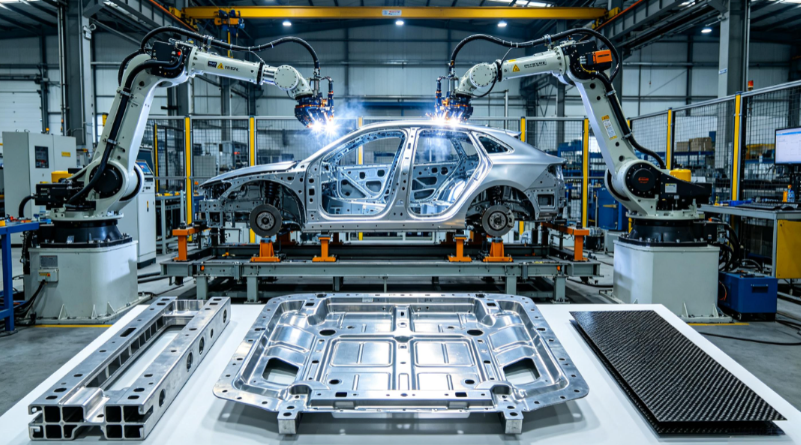
Why Weight Reduction Matters in the Automotive Industry
Vehicle mass affects several aspects of vehicle performance.
Reducing component weight can lower the energy required to accelerate and operate a vehicle. In vehicles powered by internal combustion engines, this can contribute to lower fuel consumption and improved fuel economy.
For electric vehicles, lower mass can reduce energy demand and support longer driving range under comparable operating conditions.
Weight reduction can also provide opportunities for engineers to redistribute the saved mass to other vehicle systems, improve payload capacity, or accommodate additional equipment.
The overall benefit depends on where the mass is removed and how the vehicle is designed.
Automotive Lightweighting for Electric Vehicles
Electric vehicles have increased demand for efficient lightweighting strategies.
A battery pack adds substantial mass to an electric vehicle, making weight management elsewhere in the vehicle increasingly relevant. Reducing the mass of the vehicle body, closures, chassis components, and other structures can help offset some of the additional battery weight.
Automotive lightweighting for electric vehicles can include:
- Lightweight body structures
- High strength steel components
- Multi material vehicle body designs
- Aluminum and composite materials
- Fiber reinforced components
- Tailored blanks
- Lightweight closures
- Integrated structural components
The best solution depends on the vehicle platform, production technology, material availability, joining process, and cost target.
High Strength Steel for Lightweight Vehicle Structures
High strength steel allows engineers to achieve required structural performance with less material in suitable applications.
Compared with conventional mild steel, higher-strength grades can provide greater strength at reduced thickness. This creates opportunities for mass reduction while retaining the mechanical properties required for the vehicle structure.
High strength steel is commonly considered for:
- Pillars
- Side members
- Roof reinforcements
- Floor structures
- Cross members
- Door reinforcements
- Crash-related structural components
- Body in White structures
The selection of a specific grade should consider strength, ductility, forming behavior, weldability, corrosion protection, and the requirements of the finished component.
Tailored Blanks for Automotive Lightweighting
Tailored blanks are another effective approach to material optimization.
Instead of producing a complete component from one sheet specification, different steel sheets can be joined before forming. The blank can therefore contain different thicknesses or grades in selected areas.
For example, a thicker high strength steel section can be used where additional structural performance is required, while a thinner section can be positioned in an area with lower loading.
This approach can reduce component weight without applying the highest material specification to the entire part.
Custom Tailor Welded Blanks
Custom Tailor Welded Blanks are manufactured by joining different sheet materials, commonly through laser welding, before the forming process.
They can combine:
- Different thicknesses
- Different steel grades
- High strength steel
- Advanced high-strength materials
- Coated materials
- Different local mechanical properties
For automotive lightweighting, this provides a way to match material distribution with the actual requirements of the vehicle component.
Laser Welded Blanks
Laser Welded Blanks can provide a precise joining method for different sheet sections.
The weld line can be positioned according to the geometry and loading requirements of the component. After welding, the blank can be stamped or otherwise formed into the required automotive part.
This process can support mass reduction, material optimization, and part integration.
Multi Material Automotive Lightweighting
Multi material design uses different materials within the same vehicle or component to take advantage of their respective properties.
A vehicle body may combine steel, aluminum, composites, and other materials depending on the performance requirements of different areas.
For example:
- High strength steel can provide structural strength.
- Aluminum can provide low density.
- Composite materials can reduce mass in selected components.
- Fiber reinforced materials can provide high specific strength and stiffness.
- Coated steels can provide structural performance with corrosion protection.
A multi material design also requires appropriate joining, manufacturing, repair, recycling, and cost considerations.
Composite Materials in Automotive Lightweighting
Composite materials are used in automotive applications where low density and specific mechanical properties are desirable.
Compared with conventional metallic materials, some composites can provide significant weight savings for selected components.
Common automotive composite technologies include:
- Fiber reinforced polymers
- Carbon fiber composites
- Glass fiber reinforced materials
- Hybrid composite structures
- Structural sandwich materials
The selection depends on component requirements, production volume, tooling, cost, impact performance, and manufacturing processes.
Carbon Fiber and Fiber Reinforced Materials
Carbon fiber has a high strength-to-weight ratio and can provide substantial mass reduction in applications where its cost and manufacturing requirements are justified.
Carbon fiber reinforced components may be considered for performance vehicles, specialized structures, and selected electric vehicle applications.
Fiber reinforced materials can also use glass or other fibers to provide a balance between weight, stiffness, strength, and cost.
However, replacing steel with carbon fiber or another composite is not automatically the best lightweighting solution. Material selection needs to consider the entire component and its production requirements.
Automotive Lightweighting and Body in White
The Body in White, commonly abbreviated as BIW, is one of the main areas for automotive lightweighting.
The BIW contains numerous structural components that determine the basic strength and stiffness of the vehicle body.
Lightweighting opportunities may include:
- Optimized sheet thickness
- High strength steel
- Tailored blanks
- Component integration
- Multi material construction
- Local reinforcement
- Improved material utilization
Custom tailor welded blanks are particularly suitable for BIW applications because material thickness and strength can be adjusted within a single pre-formed blank.
Lightweight Vehicle Body Structures
The vehicle body must meet structural, crash, durability, NVH, corrosion, and manufacturing requirements.
A lightweight vehicle body therefore requires more than simply reducing sheet thickness.
Engineers can optimize the body structure by determining where higher strength, additional thickness, or reinforcement is actually required.
Areas with higher structural loads may use stronger or thicker material, while less demanding areas can use thinner material.
This localized approach can achieve weight savings while maintaining the required vehicle body performance.
Weight Reduction Through Material Optimization
Material optimization is often more practical than replacing every component with a low-density material.
For example, a conventional steel component may use one sheet thickness across its entire surface. If only part of the component requires the higher thickness, a tailored blank can place thicker material in that area and thinner material elsewhere.
This can reduce:
- Component weight
- Raw material consumption
- Unnecessary reinforcement
- Secondary joining operations
The resulting weight savings depend on the component geometry, material combination, production volume, and forming process.
Manufacturing Processes for Lightweight Automotive Components
Automotive lightweighting must work within the requirements of high-volume manufacturing.
Common manufacturing processes include:
- Laser welding
- Stamping
- Deep drawing
- Hot forming
- Roll forming
- Casting
- Injection molding
- Composite molding
- Automated assembly
For steel lightweighting, the production process must be compatible with the selected grade and thickness.
For composite and fiber reinforced components, molding conditions, fiber orientation, resin system, curing, dimensional stability, and joining methods also need to be considered.
Cost Effective Lightweighting
A lightweighting solution needs to make technical and economic sense.
Cost effective lightweighting does not necessarily mean choosing the least expensive material. A slightly higher material cost may be justified if it reduces component mass, eliminates parts, simplifies assembly, or improves manufacturing efficiency.
The overall evaluation can include:
- Material cost
- Tooling cost
- Welding and joining cost
- Production cycle time
- Component count
- Assembly requirements
- Vehicle weight savings
- Production volume
- Service requirements
For high-volume automotive manufacturing, the relationship between material cost and manufacturing efficiency is especially important.
Corrosion Resistance and Lightweight Vehicle Design
Corrosion resistance needs to remain part of the material selection process.
Automotive body components can be exposed to moisture, road salt, temperature changes, and other environmental conditions.
Depending on the application, manufacturers may use coated steel, corrosion-resistant alloys, protective treatments, or composite materials.
When combining different materials in a multi material structure, engineers also need to consider the potential for galvanic corrosion and the compatibility of joining methods.
Tailored Blanks vs Conventional Blanks
A conventional blank normally uses one material specification throughout the sheet.
A tailored blank can combine different material specifications within the same blank.
| Feature | Conventional Blank | Tailored Blank |
|---|
| Material specification | Usually uniform | Can vary by section |
| Thickness | Generally uniform | Can be different |
| Strength | Generally uniform | Can be locally optimized |
| Material utilization | Less localized | More application-specific |
| Weight reduction | Limited by uniform specification | Greater optimization potential |
| Joining | Performed after forming when required | Material sections joined before forming |
Tailored blanks are particularly useful when a component contains areas with substantially different structural or forming requirements.
Lightweighting Across the Vehicle
Automotive lightweighting can be applied to many vehicle systems.
Body Structure
High strength steel, tailored blanks, and optimized sheet thickness can reduce the mass of the vehicle body while maintaining structural requirements.
Doors and Closures
Door structures can use tailored material layouts to place reinforcement where it is required without increasing the thickness of the entire component.
Chassis Components
Chassis structures can benefit from high-strength materials and optimized geometries.
Battery Structures
Electric vehicle battery enclosures require a balance between weight, stiffness, impact protection, thermal requirements, and corrosion resistance.
Interior Components
Fiber reinforced and composite materials can reduce the weight of selected interior structures and components.
Designing an Automotive Lightweighting Solution
An effective solution starts with the component rather than a specific material.
The engineering process can include:
- Define the component performance requirements.
- Identify high-load and low-load regions.
- Evaluate existing component weight and material distribution.
- Select appropriate materials.
- Compare uniform and tailored material configurations.
- Review manufacturing processes.
- Evaluate joining requirements.
- Analyze tooling and production costs.
- Validate the finished component.
- Optimize the design for volume production.
This process allows manufacturers to compare steel, tailored blanks, multi material structures, composite materials, and fiber reinforced alternatives based on actual application requirements.
Why Choose Custom Tailor Welded Blanks for Lightweighting?
Custom Tailor Welded Blanks provide a practical solution when different areas of an automotive component require different material properties.
They allow engineers to combine material thicknesses and grades before forming rather than adding reinforcement after the component has been manufactured.
Potential benefits include:
- Weight reduction
- Improved material utilization
- Localized strength
- Reduced component weight
- Fewer individual components
- Reduced joining operations
- Efficient use of high strength steel
- Support for automotive lightweighting
- Compatibility with high-volume manufacturing
Frequently Asked Questions
What are automotive lightweighting solutions?
Automotive lightweighting solutions are materials, designs, and manufacturing approaches used to reduce vehicle or component weight while maintaining required strength, durability, safety, corrosion resistance, and production performance.
How does weight reduction improve vehicle efficiency?
Reducing vehicle mass generally lowers the energy required to accelerate and operate the vehicle. It can contribute to improved fuel economy and lower fuel consumption in conventional vehicles and can help reduce energy demand in electric vehicles.
What role does high strength steel play in automotive lightweighting?
High strength steel can provide the required structural performance at lower thickness than conventional steel in suitable applications. This allows engineers to reduce component weight while maintaining the required strength.
What are tailored blanks?
Tailored blanks are sheet assemblies made from different material sections that are joined before forming. Different thicknesses or steel grades can be positioned according to the requirements of the finished component.
What are Custom Tailor Welded Blanks?
Custom Tailor Welded Blanks are application-specific tailored blanks manufactured by joining different sheet materials, often using laser welding. They can be designed around the thickness, strength, geometry, and forming requirements of a particular automotive component.
How can tailored blanks reduce component weight?
Tailored blanks can place thicker or stronger material only where it is needed. Lower-load areas can use thinner material, reducing unnecessary material across the complete component.
Are lightweighting solutions suitable for electric vehicles?
Yes. Lightweighting is widely considered for electric vehicles because reducing vehicle mass can lower energy consumption and help support driving range.
Can carbon fiber replace steel in automotive components?
Carbon fiber can replace steel in selected applications where its low density and mechanical properties provide sufficient benefits to justify its material and manufacturing costs. It is not suitable for every component.
What are composite materials used for in automotive lightweighting?
Composite materials can be used for selected structural, body, interior, and other components where low density, stiffness, strength, or specific functional properties are required.
What are fiber reinforced automotive materials?
Fiber reinforced materials combine a polymer or other matrix with reinforcing fibers such as carbon or glass fiber. They can provide high specific strength and stiffness while reducing component weight in suitable applications.
How does lightweighting affect the Body in White?
Lightweighting can reduce Body in White mass through high strength steel, optimized sheet thickness, tailored blanks, multi material structures, component integration, and localized reinforcement.
Is automotive lightweighting cost effective?
It can be cost effective when the weight savings and manufacturing benefits justify the material, tooling, and processing costs. The best approach depends on production volume, component design, and vehicle requirements.
Does lightweighting affect corrosion resistance?
It can, depending on the material and manufacturing approach. Coated steels, corrosion-resistant materials, appropriate joining methods, and protective treatments can be used to maintain the required corrosion resistance.
What manufacturing processes are used for automotive lightweighting?
Depending on the material and component, manufacturing processes can include laser welding, stamping, deep drawing, hot forming, casting, injection molding, composite molding, and automated assembly.
Conclusion
Automotive lightweighting solutions combine material selection, structural design, and manufacturing technology to reduce vehicle mass without sacrificing the performance requirements of the finished vehicle.
High strength steel, Custom Tailor Welded Blanks, Laser Welded Blanks, tailored blanks, multi material structures, composite materials, carbon fiber, and fiber reinforced materials each offer different opportunities for weight reduction.
For the automotive industry and electric vehicles, the most suitable approach depends on the vehicle body, component requirements, production processes, cost targets, and required durability. A well-designed lightweighting strategy focuses on using the right material in the right location while maintaining an efficient path from material production to the finished component.